

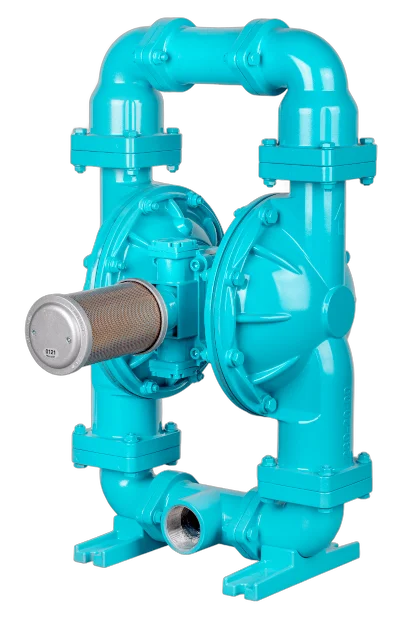
An air-operated double-diaphragm (AODD) pump is a positive-displacement pump type that operates using compressed air and does not have an electric motor. It is used in a very wide range of applications, from corrosive chemicals to thick slurries, and from food products to paint. However, selections based solely on the “maximum flow rate” figure in catalogs often result in insufficient capacity or unexpected air bills in the field.
In this guide, we discuss the four criteria that determine AODD selection: operating point (flow rate + pressure), actual air consumption, suction lift, and diaphragm material. The example values are taken from the technical data sheets of the diaphragm pump series we offer.
How does an AODD pump work?
The air valve in the center of the pump directs compressed air sequentially into the two diaphragm chambers. As air pressure pushes one diaphragm forward, the opposite diaphragm is pulled back by the common shaft: one side discharges while the other suctions. Four check valves (one intake and one discharge valve in each chamber) ensure unidirectional flow. The pilot valve reverses the air flow at the end of the stroke to maintain the cycle.
This simple design has three important practical results:
- It can run dry. There are no mechanical seals subject to friction or bearings that require lubrication; the pump will not be damaged if it runs dry. In a centrifugal pump, the same situation would result in the seal burning out.
- It can stall against a closed valve. If the discharge line closes, the pump equalizes the pressure and stops; there is no risk of explosion, overpressure, or motor burnout. When the valve reopens, the pump resumes operation automatically. For this reason, a bypass line is not required in most applications.
- It operates without electricity. In explosive environments (ATEX zones), it eliminates the risk associated with electric motors. However, the pump must be grounded to prevent static electricity buildup—a step that must not be overlooked, especially when handling solvents and flammable liquids.
Flow and Pressure: The 1:1 Rule
The most critical feature of the AODD pump is this: the maximum fluid pressure it can deliver is equal to the air pressure you supply. If your air line delivers 6 bar, the pump will deliver approximately 6 bar; if it delivers 8.4 bar, the pump will deliver 8.4 bar. In other words, the fluid pressure is determined by the air pressure.
The technical specifications for the AP 20 metal-diaphragm pump we offer clearly illustrate this relationship: operating air pressure 0–8.4 bar, discharge head 0–84 mss (meters of water column). Since 84 mss ≈ 8.4 bar, the two values correspond exactly.
Here’s the catch: the maximum flow rate listed in the catalog is measured at zero discharge pressure (free flow). For the AP 20, this value is 565 liters per minute. However, if there is 4 bar of back pressure in your line, the actual flow rate will be significantly lower than this figure. The correct selection is made using the manufacturer’s performance curve: you plot your target flow rate against your line’s actual back pressure and determine which air pressure corresponds to that point.
Rule of thumb: Do not operate the pump continuously at maximum capacity. An AODD operating at 60–80% of its nominal flow rate consumes less air and significantly extends diaphragm life.
Air consumption: the overlooked operating cost
The purchase price of an AODD pump is low; the real cost is compressed air. Compressed air is one of the most expensive forms of energy in a factory and is the most frequently overlooked factor in AODD selection.
Again, from the AP 20 brochure: air consumption is 33–169 m³/h, with a 3/4" air connection. Let’s look at the upper limit—169 m³/h is approximately 2.8 m³/min of free air, and a 20 kW-class compressor is required to meet this demand. Since the same pump delivers a maximum of 565 liters per minute (≈34 m³/h) of liquid, the air-to-liquid volume ratio is roughly 5:1.
So when making your selection, ask yourself this question: Can my existing compressor supply this pump along with other consumers? Insufficient air supply means the pump will slow down and the target flow rate will never be reached.
Applications That Reduce Air Consumption
- Do not reduce the air line diameter. Connecting a 1/2" hose to a pump that requires a 3/4" inlet creates a pressure drop and slows down the pump.
- Set the pressure to the required level. Supplying 7 bar when 3 bar is sufficient unnecessarily increases air consumption. Installing a pressure regulator on the air inlet is the most cost-effective way to save air.
- If you need to reduce flow rate with a valve, do so on the discharge side. Restricting flow on the suction side causes cavitation and diaphragm fatigue.
- Be careful of exhaust freezing. Expanding air cools; in humid conditions, the exhaust silencer may freeze and become clogged. Using dried air eliminates this problem.
Suction head: it differs between dry and wet conditions
AODD pumps are self-priming; they can be mounted above the liquid level. However, there are two different suction values that are often confused:
- Dry suction: The height that can be reached when the pump and suction line are empty. Typically ranges from 3.5 to 5 m.
- Wet suction: The height that can be reached when the diaphragms and line are wet. This can reach around 8 m.
In the AP 20 data sheet, this value is listed as 6–8 m. It is safest to design the system based on the dry suction value: do not assume the line will be full every time the pump starts up.
As viscosity increases, suction capacity decreases. For high-viscosity fluids, positioning the pump below the liquid level (submerged suction) is the most reliable solution. For the relationship between suction-side losses and NPSH, please refer to our NPSH and cavitation guide.
Diaphragm material: the most critical decision
The majority of AODD failures stem from the wrong diaphragm material. Two criteria are evaluated together during selection: chemical resistance and flex life. The material most resistant to chemicals is not necessarily the one with the longest mechanical lifespan—this trade-off is at the heart of the selection process.
| Material | Temperature range | Strengths | What to Avoid | Flex life |
|---|---|---|---|---|
| Santoprene (TPE) | −23 … +120 °C | General-purpose; acids/bases, wastewater | Aromatic and chlorinated solvents | Very good |
| PTFE (Teflon) | +4 … +100 °C | Broadest chemical resistance; concentrated acids, solvents | — | Poor (rigid structure) |
| EPDM | −50 … +100 °C | Hot water, bases, ketones | Oils and hydrocarbons | Good |
| NBR (Buna-N) | −12 … +82 °C | Petroleum products, oils, fuels | Strong acids, ketones | Good |
| FKM (Viton®) | −29 … +120 °C | High temperature, aromatic/chlorinated hydrocarbons, aggressive acids | Hot concentrated bases | Low |
| Neoprene | −18 … +93 °C | Economical, general-purpose | Strong oxidizers | Very good |
The most commonly used solution in practice is a two-piece diaphragm: the surface facing the fluid is PTFE, with Santoprene or FKM as a backing. This combines the chemical resistance of PTFE with the service life of the elastomer. This is generally the right choice when aggressive chemicals and a long service life are required.
The AP 20 datasheet lists the following options for the inner material: Neoprene, Buna-N, Teflon, Viton, Santoprene, and EPDM; for the body, the options are aluminum, cast iron, and stainless steel (316). You should base your material selection not only on the diaphragm but also on all parts in contact with the fluid (body, manifold, ball, seating surface, O-ring)—our chemical compatibility guide, which covers this topic in detail, explains this chain of components.
Body Material and Solids Pass-Through
The choice of body material is both a chemical and a mechanical decision:
- Aluminum: Lightweight and economical; commonly used for transferring oil, paint, and solvents. Not suitable for acids or saltwater.
- Cast iron: Heavy-duty, abrasive slurries; impact-resistant.
- Stainless steel (316): Food, pharmaceuticals, and most chemicals. Caution is advised regarding pitting corrosion in chloride-containing environments.
- Polypropylene (PP) / PVDF: Superior to metal in acids and bases. Our AP series with plastic housings meets this need.
One of the AODD’s standout capabilities is its ability to handle solid particles: for the AP 20, this value is 6 mm. This is a significant advantage over centrifugal pumps in applications involving slurry and sediment. However, abrasive solids quickly wear down the diaphragm and balls; for such applications, the heavy-duty (APH) series should be considered.
Pulsation and Installation Errors
AODD flow is inherently pulsating. This pulsation causes the line to vibrate, distorts flowmeter readings, and strains equipment such as filters and membranes. The solution is to install a pulsation dampener in the discharge line. In precision dosing or filtration applications, this is not an option—it is a necessity.
Other common errors encountered in the field:
- Selecting a suction line that is too narrow at the pump inlet (the suction diameter must be at least as large as the pump inlet).
- Elevations or depressions in the suction line that create air pockets.
- Connecting the pump directly to a rigid pipe—vibration can crack the manifold; use a flexible connection.
- Supplying lubricated (oiled) compressed air; modern AODD pumps operate with oil-free air, and oil can damage the pilot valve.
- Failure to ground the system — risk of static sparks with flammable liquids.
Selection Checklist
- Fluid: Chemical name, concentration, temperature, density, viscosity, solids content, and particle size.
- Operating point: Target flow rate (L/min) and actual back pressure (bar)—not the maximum value.
- Air source: Available pressure (bar) and free air capacity (m³/h). Does it meet the pump’s requirements?
- Suction configuration: Choked suction or lift? If lift, design based on dry suction values.
- Materials: Housing + diaphragm + ball + O-ring combined; the weakest link determines the design.
- Environment: Is it an ATEX zone? Are grounding and conductive material requirements necessary?
- Auxiliary equipment: Pulse dampener, regulator, flexible connection, exhaust line routing.
You can explore the AP, APX, and APH series, as well as Seko Duotek models—available with metal, plastic, hygienic, and heavy-duty housing options—in our diaphragm pumps category; share your application data to receive model recommendations from our technical support team.