


Choosing a pool pump often starts with the question, “How many horsepower should it be?”—but the right question is: How long do I want it to take to circulate all the water in the pool through the filter? Motor power is the result of this calculation—not the starting point.
In this guide, we size a pool pump in three steps: turnover time → flow rate → total head; then we address filter compatibility and energy efficiency.
Step 1 — Turnover Time
Turnover time is the time required for all the water in the pool to pass through the filter once. Standard practice:
- Private/residential pools: 4–6 hours
- Heavily used and public pools: shorter turnover time (typically 4 hours or less); applicable health regulations are the determining factor
As the turnover time decreases, water quality improves, but the pump and filter must be larger.
Step 2 — Required Flow Rate
Flow rate (m³/hour) = Pool volume (m³) ÷ Turnover time (hours)
Example: A pool measuring 8 m × 4 m with an average depth of 1.5 m:
- Volume = 8 × 4 × 1.5 = 48 m³
- For a 6-hour circulation cycle: 48 ÷ 6 = 8 m³/hour
- For a 4-hour turnover: 48 ÷ 4 = 12 m³/hour
If the pool is not a regular prism (variable depth, free-form), calculate the volume by dividing it into sections. In pools with overflow channels, the volume of the balancing tank must also be taken into account.
Step 3 — Total Delivery Head (TDH)
This is the step most often skipped and the one that leads to the most errors. The “12 m³/h” value in the catalog applies to a specific head. The pump does not produce a single value but rather a curve: as the back pressure increases, the flow rate decreases.
The total head is the sum of the following components:
- Filter resistance — a clean sand filter typically has a resistance of a few meters; this increases as the filter becomes clogged (the pressure gauge indicates this).
- Pipe friction — increases with diameter, length, and flow rate. Using a pipe that’s too small is the most common mistake.
- Local losses — elbows, valves, skimmers, bottom drains, and return inlets.
- Static head — the elevation difference between the pump and the water level.
- Additional equipment — heat pump, salt chlorine generator, UV, automatic valve. Each of these adds additional resistance and is often not factored in.
The correct selection is to find the point on the pump curve where the target flow rate intersects the Total Head (TDH). This point should be close to the center of the pump’s efficiency band.
Filter compatibility: Limit the pump based on the filter
Sand filters have a surface velocity limit: the maximum flow rate that can pass through a unit of filter area. When the pump pushes water above this limit:
- Water passes through the sand bed too quickly and is not filtered sufficiently—the pool remains cloudy.
- The sand bed may wash out, or sand may be carried away.
- Pressure loss and energy consumption increase unnecessarily.
Rule: The filter’s nominal flow rate must be equal to or greater than the pump’s operating flow rate. The assumption that “a more powerful pump means a cleaner pool” is incorrect; a pump that is too large for the filter will impair filtration.
Sufficient flow rate is also required for backwashing; the filter and pump must be selected together.
Suction System and Pre-Filter
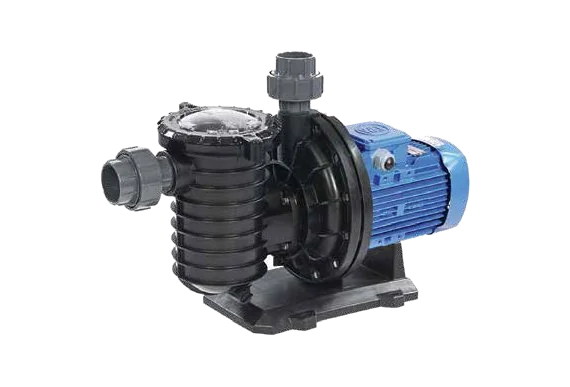
Pool pumps are typically self-priming and equipped with a pre-filter basket; they trap coarse debris such as leaves and hair. Regular cleaning of the basket is the easiest way to prevent flow loss.
If the pump is above the water level, it creates suction lift, which poses a risk of cavitation—especially in long suction lines and on hot days. Position the pump as close to the water level as possible and within a short distance from the plumbing system. For more on the physics behind this, see our NPSH and cavitation guide.
Pipe diameter: the silent constraint that determines flow rate
The most common mistake in pool plumbing is upgrading the pump while leaving the piping as is. As the water velocity inside the pipe increases, friction loss increases proportionally to the square of the velocity; beyond a certain point, a more powerful pump does not produce more flow, but only a higher electricity bill.
Standard velocity limits for pool systems:
- Suction line: Should not exceed approximately 1.5 m/s—exceeding this causes cavitation and noise.
- Discharge line: An upper limit of approximately 2.0–2.5 m/s is accepted.
Flow rate a pipe can carry: Q (m³/hour) = cross-sectional area (m²) × velocity (m/s) × 3600. For example, in a pipe with an inner diameter of 50 mm, the cross-sectional area is 0.00196 m²; at a suction velocity of 1.5 m/s, the flow rate it can carry is ≈ 10.6 m³/hour. In a system targeting 16 m³/h, this pipe would be insufficient for suction, and a larger diameter must be used.
Rule: The suction pipe is always selected one size larger than the discharge pipe.
Safety: Suction Inlet and Entrapment Risk
In pool plumbing, the suction side is not just a hydraulic issue but also a safety concern. A single bottom suction inlet creates a serious vacuum if it becomes blocked and can lead to entrapment accidents.
- Bottom suction must be taken from at least two separate inlets spaced sufficiently apart; this ensures that flow continues even if one becomes blocked.
- Suction grates must comply with standards, be sized according to flow rate, and be securely fastened.
- Skimmer and bottom suction flow rates must be balanced using valves; surface debris is removed via the skimmer, while bottom sediment is removed via the bottom suction.
In public pools, this matter is regulated by current legislation; the relevant regulations must be followed during the design phase.
Energy: Why does variable speed provide benefits?
The laws of affinity apply to centrifugal pumps:
- Flow rate ∝ speed
- Head ∝ speed²
- Power ∝ speed³
Here’s what this means: if you cut the speed in half, the flow rate drops by half, but power consumption drops to one-eighth. You’ll need to double the time to filter the same volume; however, net consumption still drops to roughly one-fourth.
Therefore, operating at low speed for a long time is significantly more economical than operating at high speed for a short time—and filtration quality also improves at low speeds. This is why variable-speed (variable-frequency drive) pool pumps have become widespread.
Materials and Water Chemistry
- Saltwater chlorine generator pools: The water is salty; chloride corrosion increases. Pumps with thermoplastic housings and appropriate stainless steel grades are preferred.
- Seawater pools: Standard 304/316 may not be sufficient; material selection should be evaluated separately.
- High chlorine/pH imbalance: This shortens the service life of seals and packing; water balance also determines the pump’s service life.
Our chemical compatibility guide provides guidance for material selection.
Example: Selection from start to finish
Pool: 10 × 5 m, average depth 1.6 m · Turnover target: 5 hours · Equipment: sand filter + heat pump
- Volume = 10 × 5 × 1.6 = 80 m³
- Required flow rate = 80 ÷ 5 = 16 m³/hour
- The filter is selected based on a surface area capable of handling a nominal flow rate of at least 16 m³/hour.
- The total head (TDH) is calculated by summing the filter, piping, heat pump, and local losses.
- The pump is selected from the curve that delivers a flow rate of 16 m³/hour at the calculated TDH—not from the highest value in the catalog.
Checklist
- Was the pool volume calculated correctly (variable depth, balance tank)?
- Is the circulation time appropriate for the intended use?
- Have the heat pump, salt chlorinator, and automatic valve been included in the TDH?
- Is the filter’s nominal flow rate ≥ the pump’s flow rate?
- Is the pipe diameter appropriate for the flow rate; is the suction line short enough?
- Has the variable speed option been evaluated?
- Has a housing material suitable for the water chemistry been selected?
If you share your pool dimensions and plumbing details, we can work together to determine the appropriate flow rate and model. You can browse the Storm, Florida Atlaspool, and Best series in our pool pumps category, or contact us.