

A dosing pump is used not to transport a liquid, but to dispense it in a measured and repeatable manner. In water treatment, chlorine and coagulants; in boiler rooms, corrosion inhibitors; in the food industry, pH regulators; and in swimming pools, disinfectants—all are dispensed using dosing pumps. Since accuracy requirements are high, the choice of technology is much more critical than for transfer pumps.
In this guide, we compare three main technologies—solenoid (electromagnetic), diaphragm, and peristaltic—and specifically address the two issues that cause the most problems in the field (back pressure and gas release).
Three Technologies, Three Different Operating Principles
Solenoid (electromagnetic) diaphragm
An electromagnet pulsically pushes the diaphragm along with the connected piston; a spring pulls it back. Each pulse displaces a fixed volume; flow rate is adjusted by pulse frequency (strokes per minute) and stroke length.
- Strengths: Compact, economical, wide adjustment range, ease of digital control. The most common solution for low flow rates (ranging from a few mL/hour to 80 L/hour).
- Limitations: Struggles under high back pressure and at high flow rates; stroke filling may be insufficient with viscous fluids.
Among the solenoid metering pumps we offer, the Seko Tekna and Kompact series fall into this category; the Tekna ATEX option is available for ATEX-compliant applications.
Motor-driven mechanical diaphragm
An electric motor mechanically drives the diaphragm via an eccentric shaft or crankshaft. The stroke motion is more powerful and stable compared to a solenoid.
- Advantages: High back pressure and high flow capacity; suitable for continuous (24/7) operation; better filling performance with viscous liquids; high accuracy.
- Limitations: Larger and more expensive; flow rate adjustment is generally based on stroke length plus motor speed.
Our mechanical metering pump lineup includes the Spring, Kosmo, and Digital Elektra series; the Invikta is available for heavier-duty applications.
Peristaltic (tube) pump
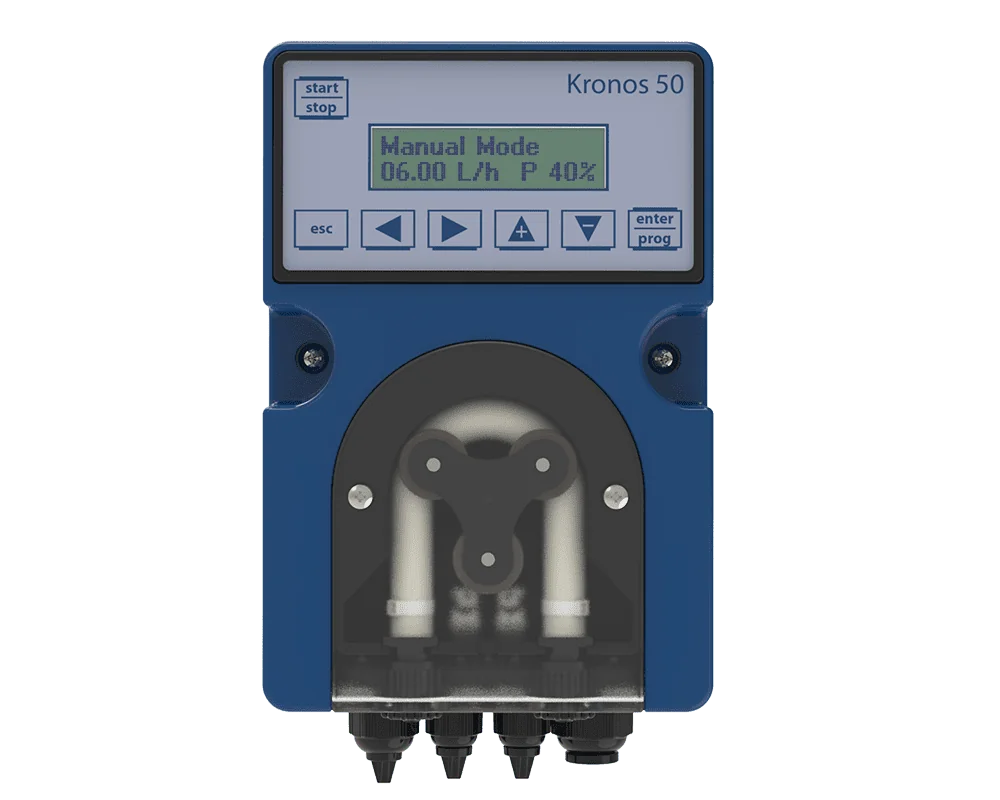
The fluid is contained solely within the tube; rotating rollers squeeze the tube to push the fluid forward. No mechanical parts of the pump come into contact with the fluid.
- Strengths: Excellent for gases, precipitating, corrosive, and viscous fluids. No valves → no place for clogging or gas buildup. Can run dry; self-priming. Material compatibility is reduced to a single component (the tubing).
- Limitations: The hose is a consumable and must be replaced periodically; pressure capacity is limited compared to diaphragm pumps.
Our peristaltic dosing pump lineup includes the Kronos series, featuring the PR, PM, PTS, and PRT models.
Comparison Table
| Criteria | Solenoid Diaphragm | Motor-driven mechanical diaphragm | Peristaltic |
|---|---|---|---|
| Typical flow range | Very low – medium | Medium – high | Very low – medium |
| Backpressure capacity | Medium | High | Low – medium |
| Gas-releasing liquid (e.g., hypochlorite) | Weak (degassing valve required) | Medium | Very good |
| Viscous liquid | Weak | Good | Very good |
| Liquid containing solids/precipitate | Poor | Weak | Very good |
| Dry operation | Limited | Limited | Problem-free |
| Consumables | Diaphragm, valve balls | Diaphragm, valves | Hose (regular replacement) |
| Initial investment | Low | High | Medium |
Choosing the Right Flow Rate: The 20–80% Rule
The most common mistake with dosing pumps is purchasing a model that is much too large, thinking, “I might need it later.” Dosing pumps operate most accurately within 20–80% of their capacity. Running a 100-liter-per-hour pump at 5% of its capacity seriously compromises accuracy: as the stroke length shortens, valve behavior and filling become unstable.
The correct approach: Calculate your actual need and select a model where that value falls within the pump’s mid-range.
Example: You want to add 2 ppm of chlorine to a line with a flow rate of 50 m³/h, and you have a 10% sodium hypochlorite solution.
Hourly pure chlorine requirement: 50 m³/h × 2 g/m³ = 100 g/h.
%For a 10% solution: 100 g ÷ 0.10 = 1,000 g/hour ≈ 1 L/hour.
In this case, a pump with a capacity of 2–4 liters per hour is ideal; a 20-liter-per-hour model would reduce accuracy.
Back pressure and siphoning: two silent errors
The dosing pump operates volumetrically; it delivers a specific volume with each stroke. However, if the pressure balance in the system is disrupted, the dosing amount may deviate from the expected value.
- Siphoning: If the pressure at the dosing point is lower than the liquid level in the chemical tank, the liquid will continue to flow on its own even if the pump stops. Result: Overdosing and an empty tank. The solution is to install a back pressure valve or a siphon breaker at the dosing point.
- Insufficient back pressure: For the same reason, the pump delivers “excessive” pressure when the back pressure is too low. A back pressure valve stabilizes the dosing in this situation as well.
- Excessive pressure: If the discharge line becomes blocked, the positive displacement pump continues to pump and may rupture the line. A safety valve must be installed on every dosing line.
A properly configured dosing line is typically set up in the following order: suction strainer and suction tube with level sensor → pump → pulsation dampener (if necessary) → safety valve → back pressure valve → injection valve.
Sodium hypochlorite: the classic “pump isn’t drawing” scenario
The most common complaint in water treatment and pool applications is that the pump stops pumping after a while during hypochlorite (bleach) dosing. The cause is not a pump malfunction: sodium hypochlorite degrades over time and releases gas. The resulting bubbles accumulate in the valve seats of the diaphragm pump, preventing the valve from seating properly and causing the pump to lose suction (gas locking).
Measures to prevent this:
- Select a pump head with an automatic degassing (air-release) valve; it returns the accumulated gas to the tank with each cycle.
- Install a submerged suction line: Position the pump below the tank level, and have the suction line run downward from the tank to the pump. This ensures that bubbles return to the tank rather than entering the pump.
- Keep the suction line short and avoid leaving any elevation that could create an air pocket.
- Choose the right materials: PP is suitable for use with hypochlorite only under limited conditions; PVDF and PTFE are much safer. Among elastomers, EPDM is inadequate, while FKM is a better choice.
- Alternatively, switch to a peristaltic pump. Since it has no valve, gas locking is physically impossible; for this reason, peristaltic solutions have become widespread in hypochlorite dosing.
Material Compatibility and Calibration
The parts of the dosing pump that come into contact with the liquid include the pump head, diaphragm, valve balls and seating surfaces, O-rings, suction/discharge hoses, and the injection valve. The weakest link in the chain determines the service life.
| Chemical | Appropriate Pump Head | Suitable elastomer | Note |
|---|---|---|---|
| Sodium hypochlorite | PVDF (preferred), PVC | FKM / PTFE | A degassing valve is recommended |
| Sulfuric acid (diluted) | PP, PVDF | PTFE / FKM | Behavior varies with concentration |
| Hydrochloric acid | PP, PVDF, PTFE | PTFE / FKM | 316 stainless steel is not suitable |
| Sodium hydroxide (20%) | PP, PTFE | EPDM / PTFE | Avoid PVDF in hot solutions |
| Polyelectrolyte / coagulant | PP, PVDF | EPDM / FKM | Viscous → peristaltic is preferable |
For a detailed material selection, refer to our chemical compatibility guide; you can also directly check the compatibility of the chemical you’ll be handling using our compatibility table tool.
Calibration: The catalog flow rate is for reference only; the actual flow rate varies depending on the line pressure and the density of the fluid. Use a calibration cylinder during commissioning: draw the fluid from the cylinder into the pump, measure the volume drawn over a specific time period, and adjust the settings accordingly. If this step is skipped, dosing errors can easily reach 20%.
Control and measurement: Switching to closed-loop dosing
Constant-flow (open-loop) dosing is sufficient where the load is constant. If water quality is variable, closed-loop control is required: a probe measures the water quality, and the control panel sends a signal to the pump.
- Proportional dosing: Dosing proportional to flow rate based on a pulse signal from the water meter.
- Measurement-based dosing: A 4–20 mA signal from a pH, ORP (redox), free chlorine, or conductivity probe.
Our control and sensor lineup includes the Control 40/42/65/100/102 and Control 800 panel series, along with probes and calibration solutions. Regular calibration of the probes is the second requirement for dosing accuracy after the pump.
Quick Selection Summary
- Low flow rate, clean chemical, economical solution → solenoid diaphragm
- High flow rate, high pressure, continuous operation → motor-driven mechanical diaphragm
- Gaseous, precipitating, viscous, or corrosive chemicals → peristaltic
If you share the chemical’s name, concentration, target flow rate, and line pressure, we can work together to determine the appropriate model and material combination—contact us or browse our dosing pumps category.